
Convective Forecast – North West England
Sunday 30 August 2026
Synoptic outlook
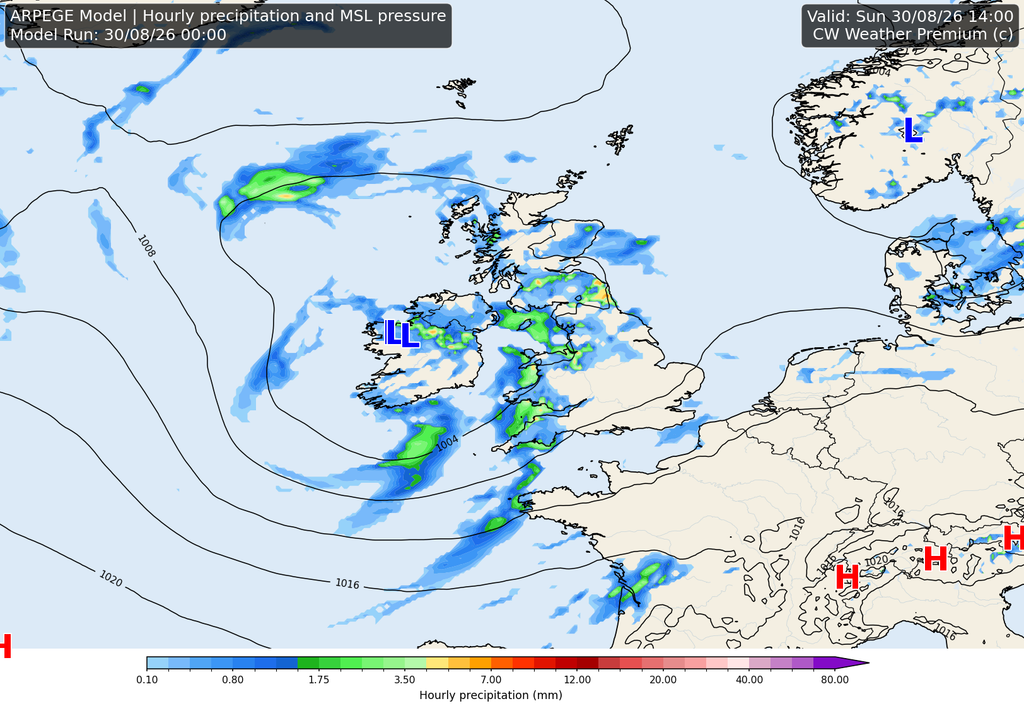
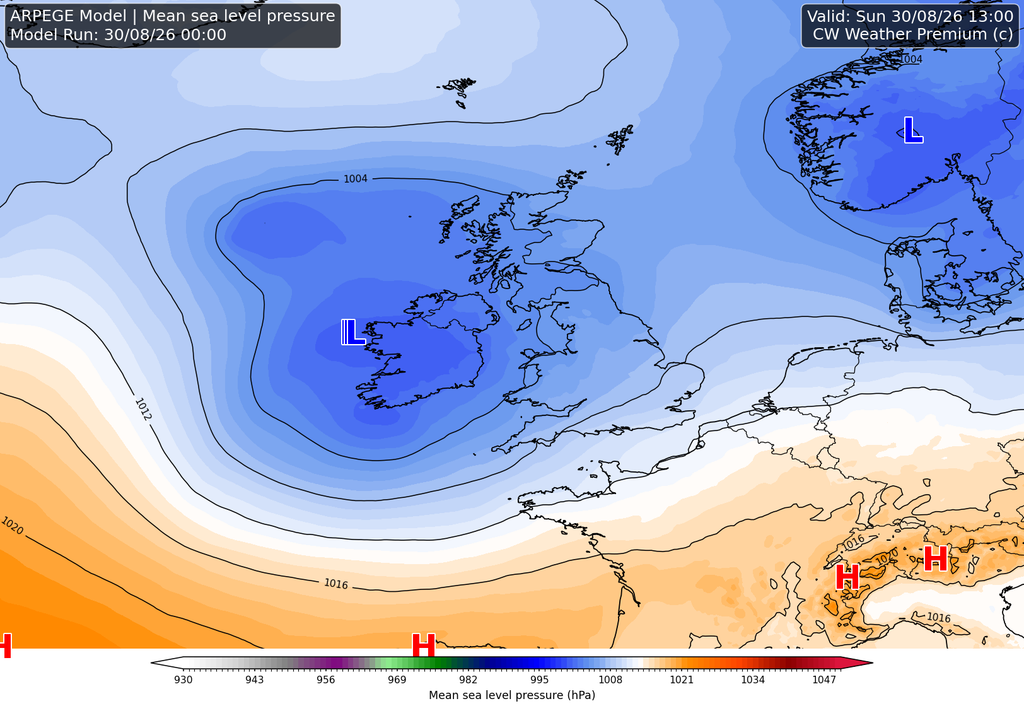
Low pressure remains the dominant feature across the British Isles today, with a complex cyclonic pattern centred close to Ireland and western parts of the UK. The region sits within a relatively slack but unstable airmass, while associated troughs and residual frontal boundaries provide additional forcing for shower development.
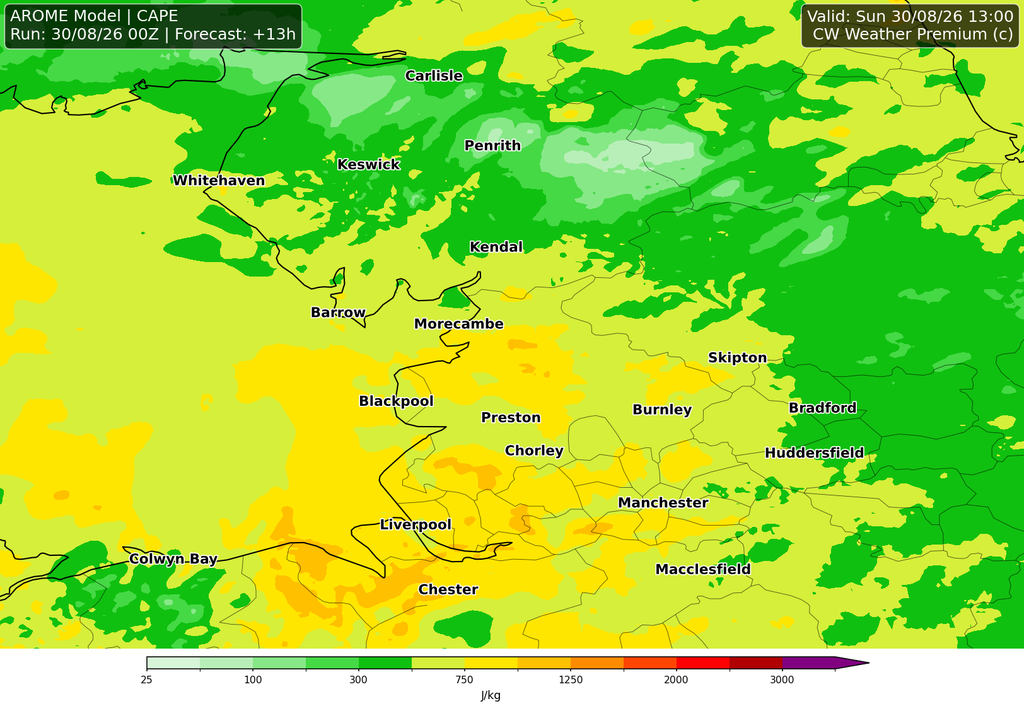
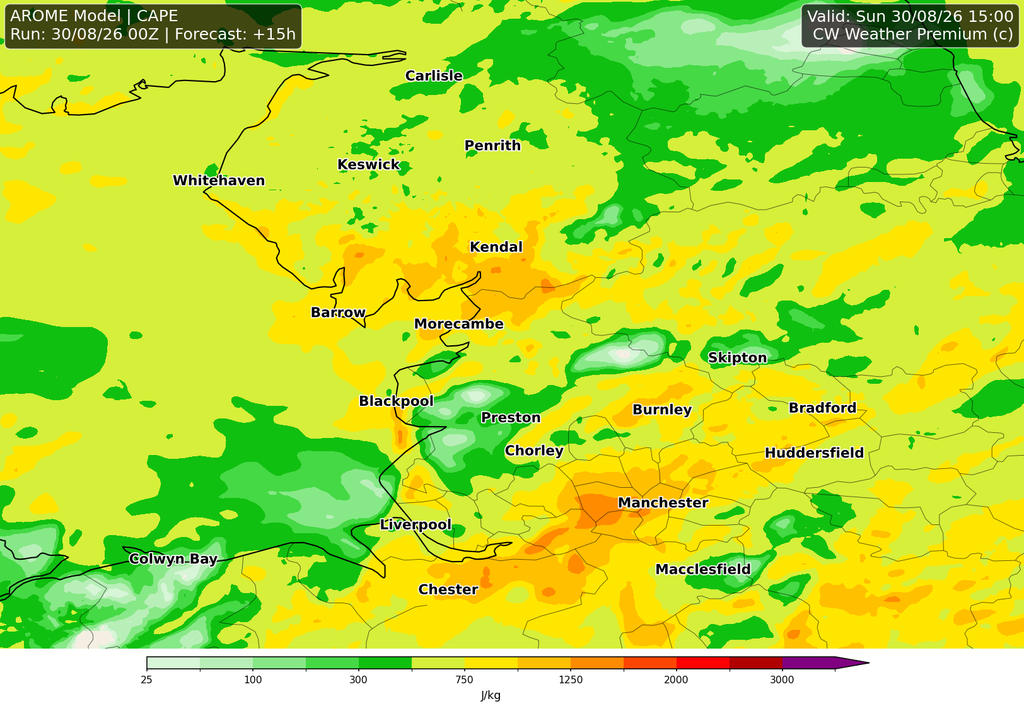
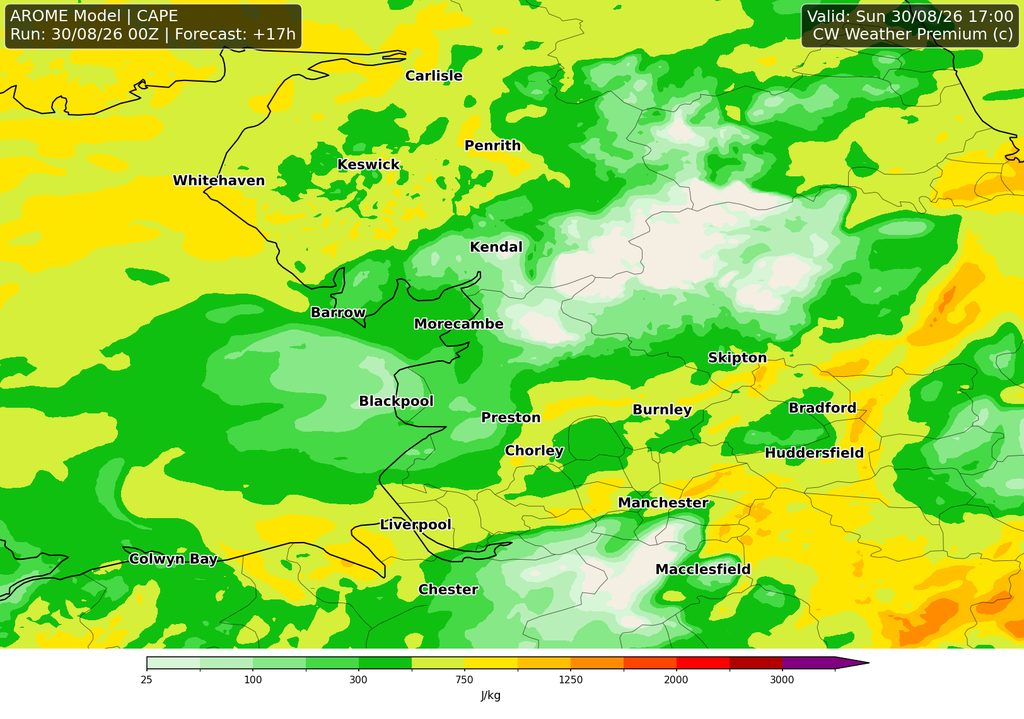
Through the afternoon, daytime heating beneath increasingly cold air aloft will help steepen lapse rates and allow instability to build quite readily. Both AROME and UKV indicate a broad reservoir of CAPE developing across North West England, with generally around 700–1500 J/kg across many southern and central parts of the region and locally higher pockets towards Cheshire, Greater Manchester and adjacent areas. The Met Office forecast is also highlighting frequent afternoon showers with hail, thunder and some localised flooding risk.
The weakly forced, cyclonic environment means convection is likely to be fairly widespread rather than organised into one narrow corridor, although convergence zones and local topography should help focus the strongest cells.
Convective detail
Following a somewhat damp or cloudy start in places, brighter intervals should increasingly develop through late morning. Once surface temperatures rise, convection is expected to initiate increasingly readily from around midday into the early afternoon.
The strongest instability initially appears focused from Merseyside and Cheshire through Greater Manchester into Lancashire, where UKV in particular develops pockets of 1000–1500 J/kg of most-unstable CAPE by around 14:00–16:00. AROME is similarly unstable, although it distributes the CAPE more broadly across the region.
Showers are therefore expected to become increasingly numerous through the afternoon, with several likely to develop rapidly into heavy downpours. Thunder and lightning are quite possible with the stronger cells, and some showers may produce small hail.
There are some indications that the most vigorous convection could favour Cheshire, Greater Manchester, Merseyside, Lancashire and areas towards the Pennines during the mid to late afternoon. However, Cumbria is certainly not excluded, particularly where orographic lift enhances shower growth. The main exception may be some higher parts of Cumbria and the Pennines where cloud contamination or earlier showers temporarily reduce surface-based instability.
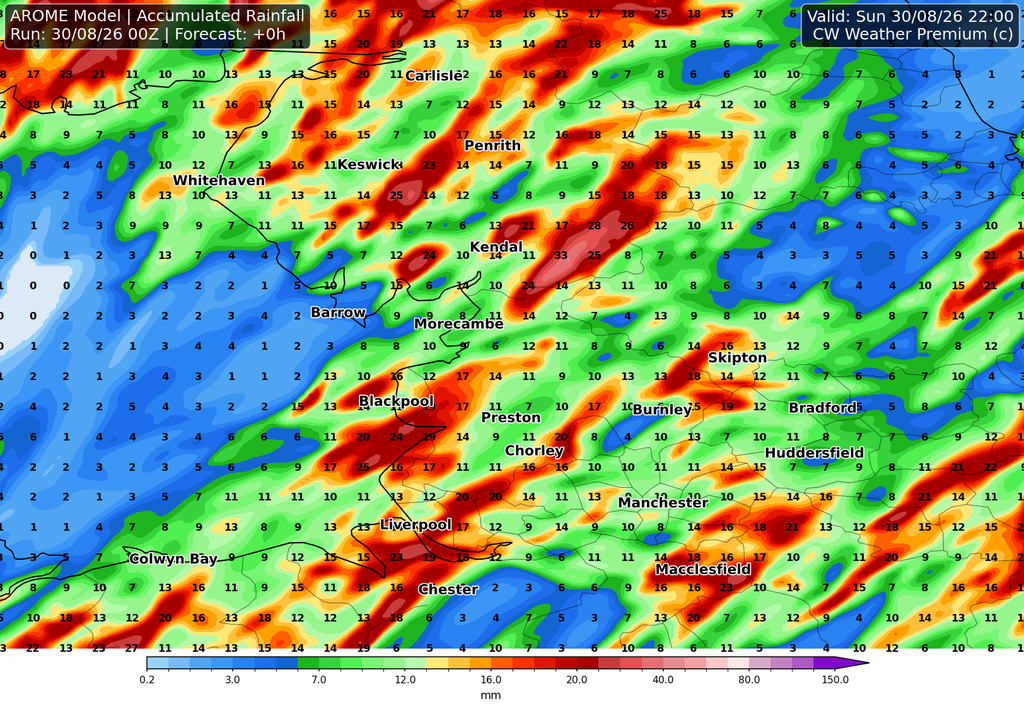
By late afternoon and early evening, individual cells may begin to merge into broader areas of heavy rain. AROME’s rainfall accumulation signal is particularly noteworthy, showing very localised totals of 20–30 mm or more where repeated showers track over similar locations. These totals should not be interpreted literally at individual points, but they highlight the potential for substantial local rainfall variation.
Given relatively slow-moving convection beneath the slack low-pressure circulation, rainfall could become the primary hazard in places. Torrential downpours may give short-lived surface-water flooding, large amounts of standing water and difficult driving conditions. The current Met Office regional forecast similarly notes a risk of localised flooding beneath the heaviest showers.
Thunderstorm risk
I would place much of North West England within a broad LOW to MODERATE thunderstorm risk, increasing to a locally MODERATE risk during the afternoon and early evening, particularly from Cheshire and Merseyside northwards through Greater Manchester and Lancashire.
The principal hazards will be:
- torrential rainfall, potentially producing 15–25 mm in a short period and locally more where cells train;
- frequent lightning from the strongest showers;
- small hail, locally perhaps briefly moderate in size;
- gusty and locally squally winds close to stronger downdrafts;
- highly localised surface-water flooding.
Severe organised thunderstorms are not currently favoured. The setup appears more conducive to pulse-type or loosely organised multicell convection, with instability considerably more impressive than the available organisation. Nevertheless, individual storms could become quite intense for a short period.
Timing
The main window for thunderstorm development looks to be approximately 12:00–20:00, with the greatest coverage and intensity likely between roughly 14:00 and 18:00. Heavy or thundery showers may continue into the evening before gradually becoming fewer later tonight.
Overall, this looks like a fairly active convective afternoon for North West England, with the chief concern being slow-moving torrential showers and highly localised flooding rather than widespread severe thunderstorms.
Forecaster: Stu